Explore our network of country and industry based websites to access localized information, product offerings, and business services across our group.
Log in to start sending quotation requests for any product.
Don't have an account? Sign Up Here
Home Hydrogen Peroxide in Healthcare: Supply Chains & Sterilization Demand Growth
Trade Insights | Supply Chain | 23 April 2026
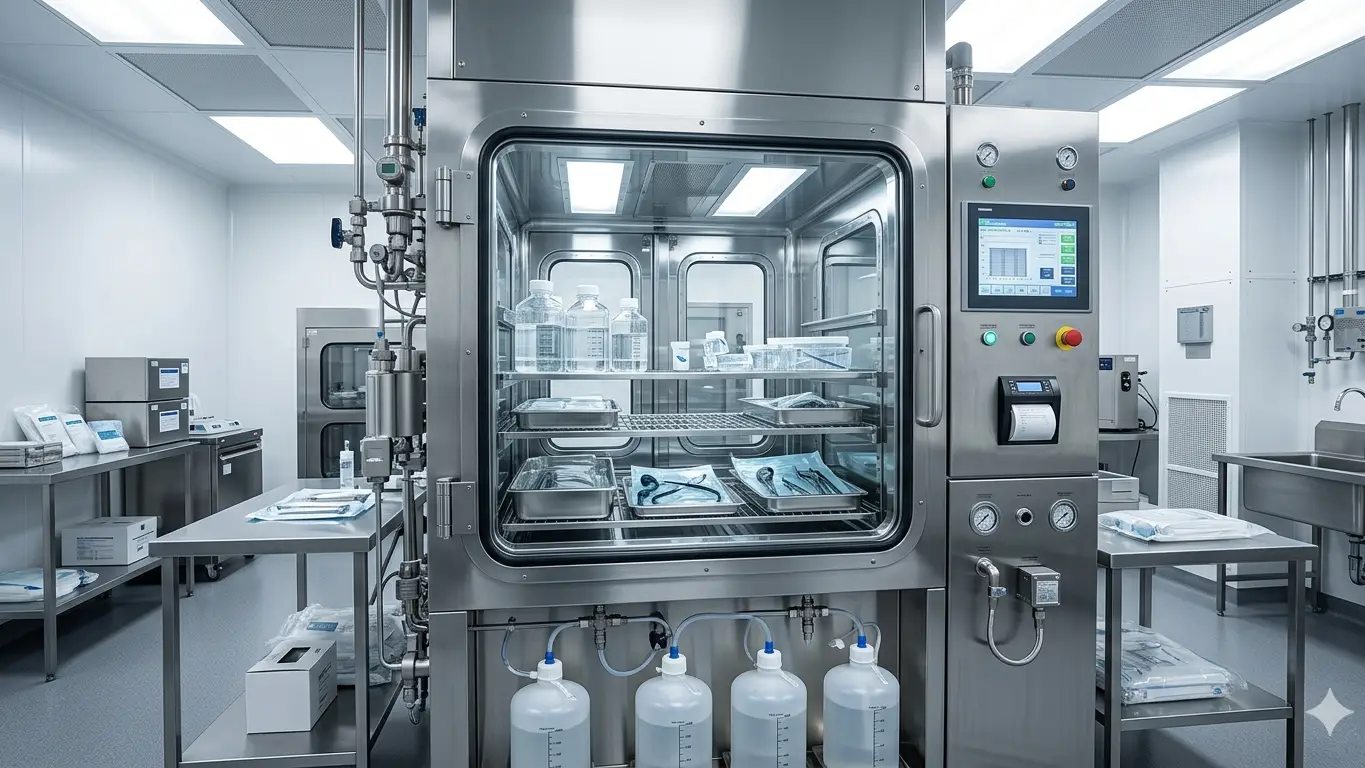
Hydrogen peroxide for healthcare sterilization is produced globally by Solvay (Belgium), Evonik (Germany), and Arkema (France), with Asia-Pacific accounting for approximately 40–45% of total capacity and China holding the largest single-country share. Healthcare-grade product moves in refrigerated tank trucks and ISO containers within regional distribution radii of roughly 500–1,000 kilometers — making it a structurally regional, not global, commodity. Demand from VHP sterilization systems is growing at 8.9% CAGR through 2026, and buyers without allocated term contracts face real exposure to regional tightness, particularly in Southeast Asia and emerging markets where logistics infrastructure cannot reliably maintain cold-chain integrity.
Hospital-acquired infections (HAIs) are a measurable, costly problem. According to the CDC's 2024 National and State Healthcare-Associated Infections Progress Report, approximately 1 in 31 U.S. hospital patients acquires an HAI during any given day. That figure drives procurement decisions at central sterile supply departments, ambulatory surgery centers, and pharmaceutical cleanrooms worldwide.
Hydrogen peroxide, particularly in vaporized form (VHP), has become the sterilization method of choice for heat-sensitive medical devices — robotic surgical instruments, endoscopes, implantable components — that cannot withstand steam autoclaving. VHP systems generate hydroxyl radicals that destroy microbial cells, including bacterial spores, without leaving chemical residues or thermally degrading polymer substrates. The FDA cleared STERIS's V-PRO low-temperature VHP systems in August 2023 for processing hospital-manufactured 3D-printed surgical guides, a signal of how broadly the technology is extending into next-generation clinical settings.
The commercial consequences are significant. The VHP sterilizers market was valued at approximately USD 1.58 billion in 2026 and is projected to reach USD 3.4 billion by 2035, expanding at an 8.9% CAGR. Broader hydrogen peroxide sterilization equipment markets — including liquid-phase and plasma-based systems — are tracking at a faster 13% CAGR in some forecast models. North America accounts for roughly 38–42% of current VHP sterilizer revenue. Asia-Pacific holds approximately 23% but is growing at the fastest regional rate (10.2% CAGR), driven by healthcare infrastructure expansion across China, India, Vietnam, and Indonesia.
The question procurement teams need to answer is whether the supply chain serving this demand is structured to support it — or whether the structural constraints of hydrogen peroxide logistics will create bottlenecks that market growth projections do not reflect.
Global hydrogen peroxide capacity stands at approximately 6.1 million tonnes in 2025, projected to reach 7.4 million tonnes by 2030. The production landscape is dominated by three Western multinationals and a fragmented base of Asian regional producers.
| Producer | Headquarters | Key Production Regions | Notable Healthcare/Pharma Capacity |
|---|---|---|---|
| Solvay | Belgium | Europe, China (Shandong JV), Taiwan | High-purity grades; EU pharmaceutical-grade qualified |
| Evonik Industries | Germany | Germany, Thailand (TPL acquisition Dec 2023), U.S. | Specialty grades; pharma and electronics segments |
| Arkema | France | France (Jarrie), China (Changshu) | Industrial and specialty grades; Albone brand |
| Kemira | Finland | Europe, North America | Paper and water treatment-oriented |
| Mitsubishi Gas Chemical | Japan | Japan, Taiwan | Electronics-grade; some healthcare overlap |
| Aditya Birla Chemicals | India | India | Regional healthcare and textile |
| Gujarat Alkalies and Chemicals (GACL) | India | India (Dahej) | Domestic healthcare and industrial |
| Taekwang / Hansol / OCI | South Korea | South Korea | Regional Asian supply |
Asia-Pacific holds approximately 40–45% of global production capacity, with China as the dominant single-country producer. Europe accounts for roughly 25–30%, with Solvay and Evonik as the anchor producers. North America holds approximately 15–20%, weighted toward the U.S. Gulf Coast and mid-continent.
The critical point for healthcare buyers is that the multinational producers — Solvay, Evonik, Arkema — hold the majority of pharmaceutical-grade and food-contact-grade capacity. Chinese regional producers, while cost-competitive, have faced persistent challenges meeting the CoA consistency and contamination control requirements that hospital systems and medical device manufacturers require. China's National Medical Products Administration (NMPA) issued revised GMP for Medical Devices in November 2025, effective November 2026, which will raise domestic standards, but the gap between Chinese commodity capacity and export-qualified healthcare-grade material remains meaningful through at least 2027.
Hydrogen peroxide is produced almost exclusively via the anthraquinone oxidation (AO) process, in which anthraquinone is hydrogenated over a palladium catalyst and then autoxidized, generating hydrogen peroxide and regenerating anthraquinone in a continuous loop. The two primary feedstock dependencies are:
Anthraquinone: Derived from benzene or naphthalene — both petrochemical derivatives. Anthraquinone costs track benzene and phthalic anhydride price cycles. When crude oil is elevated, anthraquinone costs rise and compress margins for producers without long-term supply agreements.
Hydrogen: Sourced primarily from steam methane reforming (SMR) of natural gas, or as a chlor-alkali byproduct. European producers are significantly exposed to natural gas price volatility, as SMR hydrogen is both an input to H2O2 synthesis and the energy backbone of the anthraquinone loop itself. European hydrogen peroxide prices reached USD 0.64/kg in December 2025, compared to USD 0.37/kg in North America and USD 0.12/kg in Northeast Asia — a differential driven largely by energy cost structure. European producers saw a 2.5% price increase between September and December 2025, underpinned by escalating electricity and natural gas costs.
Energy (electricity): The anthraquinone process is electricity-intensive. European producers operating under carbon pricing mechanisms carry a structural cost disadvantage relative to Chinese producers on coal-dominant grids. This is why Solvay's March 2025 announcement of a renewable-powered electronic-grade hydrogen peroxide facility in Casa Grande, Arizona, is strategically significant — it signals a deliberate move toward energy-differentiated production positioning, not merely capacity expansion.
For healthcare-grade buyers, feedstock dynamics translate directly into procurement risk. When natural gas prices spike in Europe — as they did in 2021-2022 — European producers cut output, reduce allocation to lower-margin industrial customers first, and prioritize pharmaceutical and electronics contracts. Healthcare buyers at the margin of producer priority lists get squeezed precisely when they need supply most.
Hydrogen peroxide is classified as a Class 5.1 oxidizing agent under the UN transport framework. Its logistics constraints are more severe than most procurement managers account for.
Concentrated solutions above 60% require temperature-controlled, UV-protected storage and transport. Even the 35% and 50% solutions used as feedstock for VHP sterilizer cartridges decompose more rapidly at elevated temperatures, releasing oxygen gas and building pressure in sealed containers. In Southeast Asian countries — Thailand, Vietnam, Indonesia, the Philippines — ambient temperatures routinely exceed the stability threshold for non-refrigerated bulk transport. Cold-chain logistics in these markets are primarily calibrated for food and pharma, not bulk oxidizing chemicals.
The practical consequence: most hydrogen peroxide producers set their economically viable distribution radius at 500–1,000 kilometers from plant gate, relying on refrigerated tank trucks or dedicated rail. Beyond that radius, hazardous material handling surcharges, temperature-control costs, and product loss during transit add more than 10% to landed cost, according to industry distribution analysis as of early 2026. Over 95% of global hydrogen peroxide is consumed within its region of production.
| Transport Mode | Concentration Suitability | Temperature Control Required | Typical Radius |
|---|---|---|---|
| Refrigerated road tanker | 35–70% | Yes (5–10°C) | Up to 800 km |
| ISO tank container (rail/road) | 35–50% | Yes for healthcare grade | 500–1,500 km (with relay cooling) |
| Chemical tanker (sea freight) | 35–50% | Partial; specialist vessels | Regional sea routes only |
| IBC (intermediate bulk container) | 3–35% | No (lower concentration) | Short haul; hospital/pharma delivery |
For healthcare-grade product specifically — high-purity, low-particulate, low-organics — bulk seaborne trade is minimal. The product moves from regional production sites to hospital procurement hubs via dedicated chemical distributors with refrigerated vehicles and certified HACCP-compliant storage. Buyers in markets without a proximate qualified producer — much of sub-Saharan Africa, parts of South and Southeast Asia, and the Middle East outside of Saudi Arabia and the UAE — face structural supply risk that is not addressable by diversifying suppliers. The supplier is already the nearest viable source.
The 8.9% CAGR in VHP sterilizer demand is real. The supply chain infrastructure needed to support it in all geographies is not uniformly in place.
Risk 1: Capacity Competition from Electronics and Solar
Healthcare is not the only sector competing for high-purity hydrogen peroxide. Semiconductor wafer cleaning requires ultra-high purity grades (parts-per-trillion metal ion levels), commanding a price premium that diverts qualified producer capacity away from pharma and healthcare allocations. Solvay is building dedicated semiconductor-grade capacity in Casa Grande, Arizona, specifically to serve the U.S. chip industry. In Asia, Solvay's Shandong joint venture with Huatai expanded in January 2024 to produce 48 kilotons/year of photovoltaic-grade H2O2 for solar panel cleaning — again, competing with healthcare buyers for specialist capacity at qualified production sites. When electronics and solar demand is strong, healthcare buyers drop in the allocation queue at multinationals.
Risk 2: Regional Tightness in Asia-Pacific Despite Overcapacity Headlines
Asia-Pacific has the highest installed production capacity globally, but the majority of that capacity is calibrated for commodity grades serving pulp, textile, and water treatment applications. Chinese producers face regulatory pressure from China's NMPA GMP revision effective November 2026, which will require demonstrably higher process controls — but retrofitting commodity plants to healthcare grade takes 18–36 months. Between now and 2027, the gap between rising regional healthcare H2O2 demand (driven by hospital expansions across ASEAN and China) and qualified healthcare-grade supply is likely to widen.
Risk 3: On-Site Generation as a Partial Mitigation
Modular on-site hydrogen peroxide generation — using electrochemical oxygen reduction rather than anthraquinone — is an emerging alternative that sidesteps the logistics problem entirely. Facilities generate dilute H2O2 directly at point of use. For VHP sterilizer cartridge supply (typically 59% concentration Vaprox or equivalent), on-site generation is not yet a viable substitute at the concentration levels required. For liquid-phase surface disinfection at lower concentrations (3–6%), it is increasingly practical. Healthcare procurement teams evaluating 2026 supply strategy should model on-site generation as a viable hedge for surface disinfection needs, freeing up externally sourced product for sterilization cycle use.
Risk 4: European Healthcare Buyers Face Price Structural Headwinds
European producers' energy cost exposure creates a persistent upward price bias for European hospital buyers and pharmaceutical manufacturers. Energy-intensive anthraquinone plants running on natural gas pay the EU carbon price on top of fuel costs. Evonik introduced carbon-neutral H2O2 in Europe in April 2024 under its Way to GO2 certificate — a premium product at a premium price. Healthcare procurement managers in Germany, France, and the UK who have not locked in index-linked or fixed-price term contracts for 2026 will face quarterly pricing uncertainty tied to European energy markets, not healthcare demand.
| Risk Factor | Region Most Exposed | Trigger Scenario | Buyer Mitigation |
|---|---|---|---|
| Grade competition from electronics/solar | Asia-Pacific, North America | Semiconductor capex boom → VHP-grade allocation diverted | Dedicated healthcare-grade supply agreements |
| Regional tightness despite capacity | Southeast Asia, South Asia | Hospital expansion exceeds local qualified capacity | 12-month term contracts with regional distributor |
| Cold-chain logistics failure | Sub-Saharan Africa, MENA, parts of SEA | Ambient temperature spike → product degradation | On-site generation or local stockpile management |
| European energy cost spike | Western Europe | Natural gas price surge → producer curtailment | Fixed-price or price-capped annual contracts |
| Chinese NMPA compliance transition | China | GMP revision Nov 2026 → domestic supply disruption | Source from Singapore, South Korea, or India as backup |
The healthcare hydrogen peroxide market operates on two fundamentally different procurement tracks, and confusing them creates supply risk.
Track 1: VHP Sterilizer Cartridge Supply
Hospitals and sterile processing departments using STERIS V-PRO, Solventum (formerly 3M), or ASP STERRAD systems purchase hydrogen peroxide in proprietary cassette or cartridge format — 59% concentration, stabilized, validated for the specific machine. This supply chain runs through the OEM or its authorised distribution network. Procurement teams have limited ability to dual-source. In June 2025, Solventum launched next-generation VHP sterilization systems incorporating both vaporized and plasma technologies, broadening the installed base that depends on its cartridge supply. Buyers of these systems should negotiate multi-year supply agreements at point of capital equipment purchase, not separately.
Track 2: Bulk Healthcare-Grade H2O2 for Pharmaceutical Manufacturing and Surface Disinfection
Pharmaceutical manufacturers, contract sterilization facilities, and hospital compounding pharmacies procure bulk hydrogen peroxide (30–35%, occasionally 50%) directly from producers or their qualified distributors. This market is accessible for term contract negotiation, origin diversification, and spot purchasing. Buyers in this track have meaningful supply chain agency. Key considerations for 2026:
Several structural forces will sustain healthcare hydrogen peroxide demand through 2026 and beyond:
Aging populations in North America, Western Europe, Japan, and South Korea are increasing procedural volumes. Medicare-certified ambulatory surgery centers in the U.S. climbed 3.8% annually through late 2024, adding compact VHP chamber demand at each new facility. The pharmaceutical and biotech sectors are expanding cleanroom footprints globally, with biologic drug manufacturing requiring validated sterilization of production equipment that cannot contact heat. China's NMPA GMP revision, while creating near-term disruption, will ultimately drive domestic hospitals toward verified sterilization protocols — a demand pull for qualified H2O2, not a supply constraint in isolation.
In September 2025, the Society for Sterility Assurance Professionals (SfSAP) established a dedicated working group on VHP sterilization, signaling formal professionalization of the field and a likely acceleration of protocol standardization. In March 2026, Picarro Inc. introduced the PI2124 Analyzer for continuous low-level VHP monitoring, enabling tighter compliance in pharmaceutical and laboratory sterilization processes. Both developments signal growing institutional commitment to VHP as a primary modality.
The one variable that could constrain demand growth is not chemical supply — it is infrastructure readiness in emerging markets. Hospitals in Nigeria, Bangladesh, Vietnam, and Brazil that lack certified cold-chain distribution networks and temperature-controlled storage facilities cannot reliably deploy hydrogen peroxide sterilization at scale, regardless of producer capacity. Market-level demand forecasts that aggregate these regions alongside mature markets may overstate near-term accessible demand.
Q: Who are the largest producers of healthcare-grade hydrogen peroxide globally?
A: Solvay (Belgium), Evonik (Germany), and Arkema (France) are the three dominant producers of high-purity, pharmaceutical- and healthcare-grade hydrogen peroxide globally. In Asia, Mitsubishi Gas Chemical (Japan) and South Korean producers including Taekwang and Hansol Chemical supply regional markets. Chinese producers hold the largest raw capacity share but are primarily oriented to commodity grades, with healthcare-grade qualification limited to a subset of facilities.
Q: How is hydrogen peroxide transported for healthcare use?
A: Healthcare-grade hydrogen peroxide (typically 35–59% concentration) is transported in refrigerated road tankers or ISO tank containers, maintained at 5–10°C throughout transit. Producers define their economic distribution radius at 500–1,000 kilometers from plant gate. Beyond this range, logistics costs escalate sharply and product degradation risk increases, particularly in tropical climates. Long-haul seaborne trade in healthcare-grade product is minimal; most supply moves regionally within 24–48 hours of production.
Q: What factors drive hydrogen peroxide prices for healthcare buyers?
A: Production cost is dominated by energy (electricity for the anthraquinone process) and hydrogen feedstock (from natural gas via SMR). European producers are most exposed to natural gas and carbon pricing volatility. In Northeast Asia, prices in December 2025 averaged USD 0.12/kg versus USD 0.64/kg in Europe — a differential reflecting structural energy cost differences. For healthcare-grade product, grade premiums and allocation tightness driven by electronics and solar sector competition further lift effective price above commodity benchmarks.
Q: What are the main supply risks for hydrogen peroxide in healthcare?
A: The primary risks are grade competition from electronics and photovoltaic sectors diverting qualified capacity, regional supply tightness in Southeast Asia and South Asia where healthcare demand is growing faster than local qualified production, and cold-chain logistics failures in tropical emerging markets that degrade product quality. For European buyers, energy cost exposure at production level creates upward price risk unrelated to healthcare demand cycles.
Q: How do hospitals and pharmaceutical manufacturers typically source hydrogen peroxide?
A: VHP sterilizer cartridge users (STERIS, Solventum, ASP systems) procure through OEM-authorised distribution networks — typically under multi-year agreements tied to capital equipment contracts. Bulk hydrogen peroxide for pharmaceutical manufacturing and surface disinfection is sourced via qualified chemical distributors or directly from producers under 12-month term contracts with CoA-defined specifications. Spot purchasing is viable but exposes buyers to allocation risk during periods of electronics-sector demand peaks, which have historically caused temporary tightness in high-purity grades.
We're committed to your privacy. Tradeasia uses the information you provide to us to contact you about our relevant content, products, and services. For more information, check out our privacy policy.


 English
 Indonesian
 简体字
简体字
 العربية
 Español
 Français
 Português
 日本語
日本語
 한국어
한국어
 Tiếng Việt



















