Explore our network of country and industry based websites to access localized information, product offerings, and business services across our group.
Log in to start sending quotation requests for any product.
Don't have an account? Sign Up Here
Home Caustic Soda Flakes in India's Textile Industry: Mercerization & Procurement
Trade Insights | Applications and Buyers | 20 May 2026
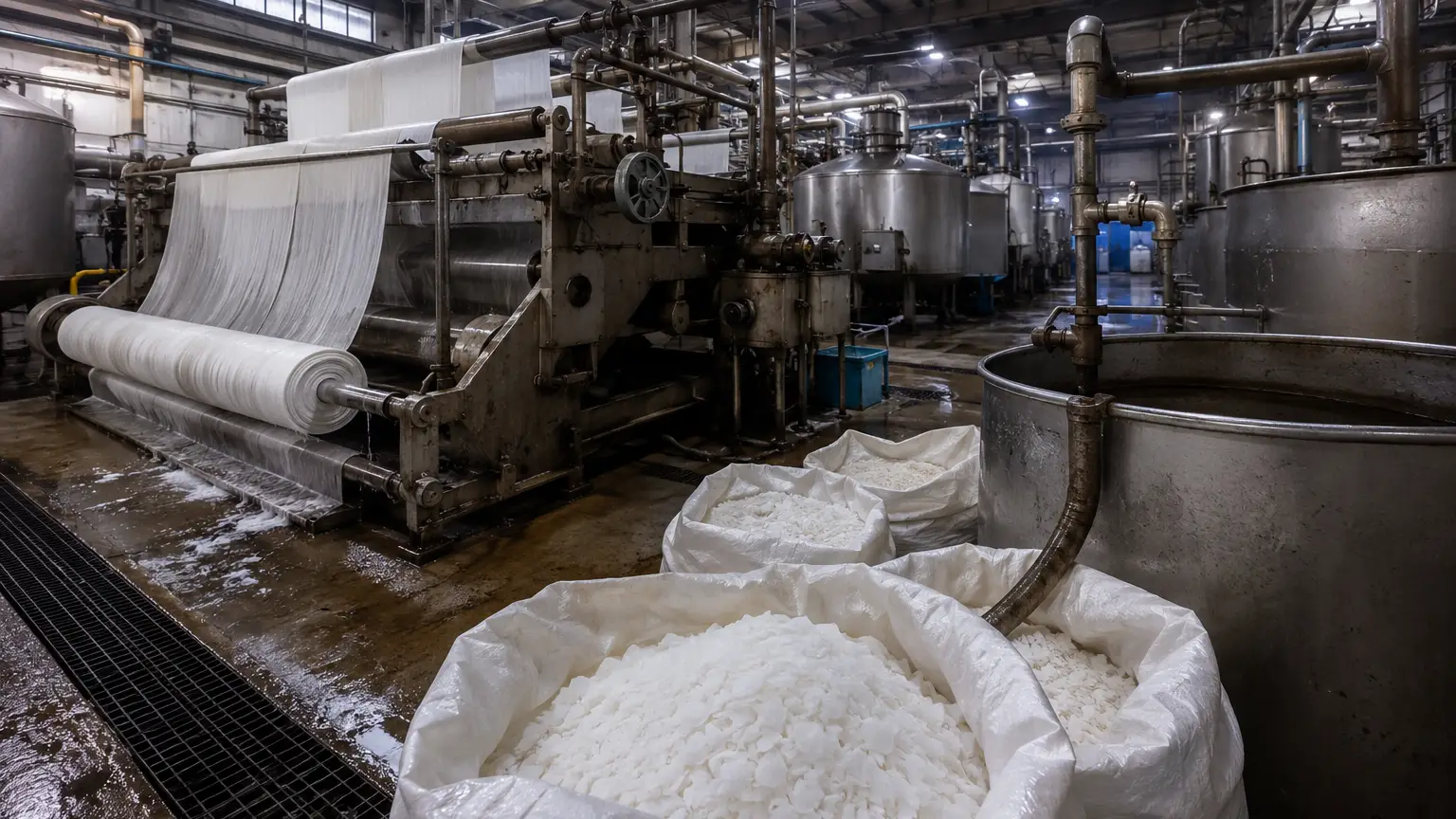
India's textile industry consumed over 4.18 million metric tons of caustic soda in 2025, with the textile sector representing one of its largest and most process-dependent buyer categories. The India caustic soda market is expected to grow at a CAGR of 5.50% between 2026 and 2035, reaching a volume of 7.14 million metric tons by 2035, driven substantially by textile industry expansion alongside chemicals, alumina, and water treatment. For textile mill operators, fabric finishers, and procurement teams sourcing caustic soda flakes in India, the chemical is not a commodity input that can be selected on price alone. The concentration applied during mercerization determines fabric luster and dye uptake. The purity grade specified for scouring baths determines whether fiber damage and discoloration risks are managed or compounded. And the reliability of flake supply, relative to liquid caustic, determines whether remote mills and batch processing operations can maintain production continuity. Understanding exactly how caustic soda flakes function across each textile processing stage, and what procurement parameters matter in each, is what separates efficient textile chemical sourcing from reactive spot purchasing.
Caustic soda reaches textile mills in two physical forms: liquid sodium hydroxide (typically 32-50% concentration) and solid flakes (typically 98-99% NaOH purity). In India's textile manufacturing landscape, flakes hold a structural advantage over liquid caustic for a significant portion of the mill base, particularly mid-scale fabric processors, dye houses, and mills located beyond the logistics reach of bulk liquid chemical suppliers.
Solid flakes allow mills to prepare process baths at precisely controlled concentrations by dissolving measured weights into water, eliminating the flow measurement errors that occur with liquid caustic dosing in batch systems. Flakes also carry no dilution penalty in transport: a truck of 98% caustic soda flakes delivers almost twice the active NaOH content per kilometer of freight compared to a truck of 50% liquid caustic. For mills in textile clusters in Tirupur, Surat, Bhilwara, Ichalkaranji, and Ludhiana, where road transport rather than pipeline distribution is the supply reality, the logistics economics of flakes are structurally favorable relative to bulk liquid.
The trade-off is handling: flakes are hygroscopic, absorbing moisture from air rapidly, which causes caking and concentration inconsistency if storage conditions are not maintained. Procurement teams specifying caustic soda flakes for textile operations must confirm that the supplier's packaging (sealed moisture-resistant bags, typically 25 kg or 50 kg) and their own warehouse conditions (covered, dry, below 30°C) can prevent moisture uptake between delivery and use. This is not a marginal concern in India's humid coastal textile clusters; it is a specification requirement that should appear in supplier qualification criteria alongside purity and price.
Scouring is the first chemical process applied to raw cotton, wool, or synthetic fiber after greige fabric is produced on the loom. Its function is to remove natural waxes, oils, pectin compounds, seed husks, and processing lubricants that contaminate the fiber surface and would prevent uniform dye penetration. Caustic soda is applied in scouring baths at concentrations of 4-10% NaOH, at temperatures of 80-100°C, saponifying the fatty acids in natural waxes and converting them into water-soluble soaps that rinse clear from the fabric.
The commercial result of effective caustic soda scouring is measurable: raw cotton fiber moisture absorbency increases by up to 300%, and the whiteness index improves by 15-25 points, creating a substrate that accepts reactive and vat dyes consistently across the full fabric width. Batch variation in caustic soda purity directly translates into batch variation in scouring effectiveness, which in turn causes uneven dye uptake — the most commercially damaging quality defect in fabric production because it forces downgrading or rework of the entire batch rather than localized correction.
For India's cotton textile clusters, particularly Tirupur's knitwear and Surat's woven fabric processing sectors, scouring is a continuous operation in many large mills, with fabric passing through caustic baths, rinse sections, and neutralization stages on automated jiggers or jet dyeing machines. Procurement teams sourcing caustic soda flakes for scouring applications typically require purity of minimum 98% NaOH, iron content below 10 ppm (to prevent iron staining on bleached white fabric), and consistent moisture content below 1% in the delivered flake to ensure stable bath concentration.
Mercerization is the single highest-value application of caustic soda in cotton textile manufacturing and the process most sensitive to caustic soda purity, concentration consistency, and delivery reliability. The process, discovered by John Mercer in 1844 and commercialized in the 1890s, immerses cotton yarn or fabric in a concentrated sodium hydroxide solution — typically 18-25% NaOH (equivalent to 20-30° Baumé) — at controlled low temperatures of 15-25°C, while maintaining the fabric under mechanical tension to prevent contraction.
At these concentrations, sodium hydroxide penetrates the cellulose crystalline structure of cotton fiber, causing irreversible swelling that transforms the fiber cross-section from its natural kidney-bean shape into a rounded, more uniform profile. This structural transformation delivers three commercial outcomes that directly affect the finished fabric's market value: luster is increased as the rounder fiber surface reflects light more uniformly, dye uptake is improved by 20-30% relative to unmercerized cotton (requiring less dyestuff for equivalent depth of shade), and tensile strength increases by 20-30%, extending garment lifespan.
In India, mercerization is concentrated in export-oriented mills producing premium cotton yarns and fabrics for European and North American retail chains, where buyers specify mercerized cotton to meet the surface quality and colorfastness requirements of premium branded apparel. Gujarat's spinning and fabric mills supply mercerized cotton yarn to global brands and serve as the reference standard for NaOH specification in this application. Caustic soda purity requirements for mercerization are tighter than for scouring: minimum 99% NaOH assay, iron below 5 ppm, and chloride content (NaCl) below 0.5% are the standard mill specifications, because impurities carry through to fabric surface effects that are visible in the finished product.
The concentration management in mercerization is commercially significant. Under-concentration (below 18% NaOH at bath entry) fails to trigger full cellulose swelling and produces inconsistent luster across the fabric width. Over-concentration (above 27%) risks fiber degradation and tensile strength reduction. Batch-to-batch concentration consistency in delivered flakes is therefore a direct production quality variable, not merely a supplier documentation formality. Mills that experience purity variation between deliveries face fabric lot inconsistencies that can trigger order rejections from export buyers.
Reactive dyeing of cotton is the dominant coloration method for India's export-oriented fabric sector, producing the washfast colors required by international apparel brands at competitive process cost. Caustic soda functions in reactive dyeing as the alkali that raises bath pH to 10-13, triggering the covalent bond formation between the reactive dye chromophore and the cellulose hydroxyl groups — the reaction that produces the dye's washfastness rather than physical adsorption that would fade with washing.
In reactive dyeing, caustic soda flakes are added to the dye bath in controlled amounts to progressively raise pH during the fixation phase, a technique called "alkali shock" in batch dyeing or a controlled gradient in continuous pad-steam processes. The concentration used, typically 5-20 g/L depending on the reactive dye system, is lower than in scouring or mercerization, but the purity requirement is equally important because contamination affects color reproducibility across batches.
India's tirupur dyeing cluster, the largest knitwear dyeing hub in Asia, processes millions of meters of cotton fabric per year using reactive dyes. Procurement teams in this cluster typically purchase caustic soda flakes from Gujarat-based producers including Gujarat Alkalies and Chemicals Limited (GACL) and through chemical distributors supplying the Tirupur Chemical Bazaar. Delivery reliability, consistent packaging weight, and documentation of NaOH assay per batch are the operational procurement priorities at this scale of production.
Before woven cotton fabrics can be scoured or dyed, the sizing agents (typically starch or PVA) applied to warp yarns during weaving to reduce yarn breakage must be removed. Caustic soda at 2-4% concentration, combined with heat at 80-95°C, hydrolyzes starch sizing effectively in a process that can be integrated with scouring in continuous processing lines. This combined desize-scour step reduces water and steam consumption compared to sequential processing, and is the preferred approach in modern integrated mills.
For procurement teams, desizing represents additional caustic soda consumption that is often absorbed into the general scouring bath chemical budget rather than tracked as a discrete application. Mills converting from batch to continuous desize-scour processes typically see total caustic soda consumption per meter of fabric processed decrease, while batch efficiency and fabric uniformity improve — a quality argument for process modernization that chemical distributors serving textile mills can support with process yield data.
India's domestic caustic soda production base, centred in Gujarat with secondary production in Andhra Pradesh, Maharashtra, and Rajasthan, supplies the majority of caustic soda flakes consumed by the textile industry. The installed capacity of the Indian caustic soda industry reached 43.96 lakh MTPA as of March 2024, with production of 35.12 lakh MTPA, at 80% capacity utilization. Key domestic producers supplying flake grades to the textile industry include Gujarat Alkalies and Chemicals Limited (GACL), Grasim Industries (Aditya Birla Chemicals), DCM Shriram, DCW Limited, and Chemplast Sanmar. In March 2025, DCM Shriram commissioned a new 300-ton-per-day caustic soda flakes plant at its Jhagadia, Gujarat complex, reflecting the industry's response to growing domestic textile and chemical demand.
For textile mills outside Gujarat, the supply chain runs through chemical distributors who aggregate flakes from multiple producers, provide local warehousing and last-mile delivery, and handle the small-lot and credit terms that direct producer relationships typically do not accommodate. The major textile clusters in Tirupur, Bhilwara, Ichalkaranji, Erode, and Ludhiana each have established chemical distribution networks that serve as the primary procurement channel for mid-scale mills.
Import procurement becomes commercially relevant when domestic flake supply tightens seasonally, when export-quality purity specifications exceed the consistent capability of domestic producers, or when mills sourcing for pharmaceutical or food-grade adjacent applications require USP-compliant material. Global chemical distributors with documented multi-origin sourcing capabilities provide textile procurement teams with supply optionality that purely domestic relationships cannot offer.
Tradeasia International, a Singapore-headquartered global chemical supplier and distributor with established supply networks across India, China, and Southeast Asia, supplies caustic soda flakes to textile manufacturers with full documentation support including batch-specific COAs, NaOH assay verification, and iron/chloride impurity profiles. For textile procurement teams managing specification-critical supply relationships — particularly export mills where batch consistency directly affects order acceptance — Tradeasia International's regional presence and multi-origin sourcing capability offers a practical alternative to single-producer dependency. Buyers can review Tradeasia International's caustic soda product portfolio for technical specifications and sourcing inquiries.
The procurement specification for caustic soda flakes in textile applications is not a single document applied across all process stages. It varies by application, and purchasing without application-specific specifications is the most common cause of process quality problems in textile chemical procurement.
For mercerization, the minimum acceptable specification is 99% NaOH assay, iron content below 5 ppm, sodium chloride below 0.5%, and moisture in the delivered flake below 0.5%. These parameters are non-negotiable for export mills supplying premium fabric. For scouring and desizing, 98% NaOH assay is typically sufficient, with iron below 10 ppm and moisture below 1%. For reactive dyeing alkali, 98% NaOH with standard impurity controls is adequate, but consistent package weight and moisture resistance in packaging are the operational specifications that matter most for dosing accuracy.
All buyers, regardless of application, should require batch-specific certificates of analysis from suppliers and should cross-check the COA iron and chloride values against their process specification on each delivery rather than assuming consistent quality between batches from the same supplier. Iron contamination in caustic soda flakes is a variable that can shift between batches from the same plant depending on production equipment conditions, and textile mills that do not check incoming batches have no early warning before a contaminated batch causes visible staining in a dyed lot.
Safety Data Sheets compliant with GHS format are mandatory for caustic soda at all concentrations and must be current, accessible, and in the language of the receiving facility's operators. Chemical burns from NaOH are among the most serious occupational hazards in textile processing environments, and procurement teams have a direct role in ensuring that SDS documentation is current and circulated to production teams with each new supplier relationship.
Two sustainability trends are changing how textile mills in India source and use caustic soda flakes, and both have procurement implications that extend beyond immediate cost and specification management.
Caustic recovery systems, which recapture diluted NaOH from mercerization rinse waters and concentrate it back to usable strength through evaporation and membrane filtration, are increasingly being installed in large-format Indian export mills. Advanced systems achieve 70-80% caustic recovery from mercerization operations, dramatically reducing fresh NaOH consumption per meter of fabric processed while simultaneously reducing the wastewater alkalinity load that requires neutralization before discharge. Mills that have invested in caustic recovery reduce their procurement volume for fresh flakes by 30-50% relative to unrecovered operations, which changes the procurement economics of the flake grade decision: when only the unconsolidated top-up requirement needs to be purchased externally, higher-purity grades become cost-competitive against lower-purity alternatives at smaller volumes.
The ZDHC (Zero Discharge of Hazardous Chemicals) programme, adopted by major international apparel brands including H&M, Zara, and Nike as a supply chain standard, imposes wastewater discharge limits on caustic soda effluent from supplier mills. Indian mills supplying these brands must demonstrate ZDHC compliance through third-party wastewater testing, which has the indirect effect of incentivizing better caustic management — more precise dosing, more consistent specification, and faster adoption of recovery systems — across the supplier base. Procurement teams at ZDHC-compliant mills should source caustic soda flakes from suppliers capable of providing environmental and safety documentation alongside standard COA data, as brand audit requirements increasingly extend to input chemical supplier documentation chains.
The India caustic soda market's projected CAGR of 4.32-5.50% through 2033-2035 is supported by two parallel structural drivers in the textile sector. India's government Production Linked Incentive (PLI) scheme for textiles is encouraging capacity investment in man-made fiber and technical textiles, both of which consume caustic soda in finishing and fiber processing steps that partially overlap with cotton textile applications. As man-made fiber blends penetrate the Indian domestic market and export apparel categories, caustic soda demand from finishing operations on these substrates adds incremental volume to the textile sector's total procurement.
The second driver is the quality upgrade in Indian textile exports following the China+1 sourcing shift by European and North American apparel brands. As brands divert more sourcing volume from China to India, the Indian mills receiving these orders face immediate specification upgrades: mercerized, reactive-dyed, and OEKO-TEX certified fabrics are the entry-level standard for global brand sourcing, all of which require specification-grade caustic soda rather than the commodity-grade material that dominates domestic market supply. This quality pull is the most commercially significant procurement shift in India's textile caustic soda market over the next five years, and it favors distributors and suppliers capable of delivering consistent, documented, specification-compliant flake grades over low-cost spot suppliers.
What are caustic soda flakes and why does the textile industry use them? Caustic soda flakes are solid sodium hydroxide (NaOH) in flake form, typically at 98-99% purity. The textile industry uses them because NaOH's strong alkalinity is essential for four key fabric processing steps: scouring (removing waxes and impurities from raw fiber), mercerization (permanently improving cotton fiber luster, strength, and dye uptake), reactive dyeing (fixing dye to fiber through covalent bonding at high pH), and desizing (removing starch sizing from woven fabric before further processing).
Why are caustic soda flakes preferred over liquid caustic soda in many Indian textile mills? Flakes allow precise bath concentration preparation by dissolving measured weights in water, avoiding the flow metering errors that occur with liquid caustic in batch systems. They also deliver higher active NaOH content per unit of freight, which matters for mills in textile clusters served by road transport rather than bulk pipeline distribution. The trade-off is that flakes require dry, sealed storage to prevent moisture absorption and caking.
What NaOH purity grade should textile buyers specify for mercerization? Mercerization requires minimum 99% NaOH assay, iron content below 5 ppm, sodium chloride below 0.5%, and delivered flake moisture below 0.5%. These specifications are tighter than for scouring (98% NaOH, iron below 10 ppm) because impurities in mercerization baths translate directly into visible fabric quality defects — inconsistent luster, streaking, and color variation — that cause lot rejections from export buyers.
How does iron contamination in caustic soda flakes affect textile production? Iron contamination in caustic soda flakes causes iron staining on bleached or light-colored fabric, appearing as yellow or brown discoloration that is either permanent or very difficult to remove in subsequent processing. Even concentrations above 10 ppm iron in the caustic soda can produce visible staining on white or pastel fabrics. Buyers should require batch-specific iron content data on every COA and check it against their specification on each delivery rather than assuming consistent quality between batches.
What are the major Indian producers of caustic soda flakes for the textile industry? Major Indian caustic soda flake producers supplying the textile sector include Gujarat Alkalies and Chemicals Limited (GACL), Grasim Industries (Aditya Birla Chemicals), DCM Shriram (which commissioned a new 300 TPD flakes plant at Jhagadia, Gujarat in March 2025), DCW Limited, and Chemplast Sanmar. Production is concentrated in Gujarat, with secondary capacity in Andhra Pradesh and Maharashtra.
What is caustic recovery and how does it affect caustic soda procurement volumes? Caustic recovery systems capture diluted NaOH from mercerization rinse waters and concentrate it back to usable strength through evaporation and membrane filtration. Advanced mills achieve 70-80% caustic recovery, reducing fresh flake procurement volumes by 30-50% and lowering wastewater alkalinity discharge. Recovered caustic at 15-20% concentration is suitable for reuse in scouring and desizing, even if it is too dilute and impure for mercerization baths.
What is the ZDHC programme and how does it affect caustic soda procurement in India? ZDHC (Zero Discharge of Hazardous Chemicals) is a programme adopted by major international apparel brands that imposes wastewater discharge limits on mills in their supply chains, including limits on alkaline discharge from caustic soda operations. Indian mills supplying ZDHC-compliant brands must demonstrate compliance through third-party wastewater testing, which incentivizes better caustic management and extends documentation requirements to input chemical suppliers. Procurement teams should source from suppliers capable of providing environmental and safety documentation beyond standard COA data.
Where can textile manufacturers in India source specification-grade caustic soda flakes with full documentation? Tradeasia International supplies caustic soda flakes to textile manufacturers across India and Asia with batch-specific COA documentation, NaOH assay and impurity profile verification, and multi-origin sourcing capability. With regional presence across India, China, Indonesia, and Singapore, and over 20 years of global chemical distribution experience, Tradeasia International supports procurement teams in export-oriented textile mills that require consistent, documented caustic soda flake supply. Contact our team for grade specifications, safety documentation, and volume pricing.
We're committed to your privacy. Tradeasia uses the information you provide to us to contact you about our relevant content, products, and services. For more information, check out our privacy policy.


 English
 Indonesian
 简体字
简体字
 العربية
 Español
 Français
 Português
 日本語
日本語
 한국어
한국어
 Tiếng Việt



















